
Personal Loan Documents: What Lenders Need in 2026

Which documents does a personal loan lender want? Search that question and you'll get a tidy list: photo ID, pay stubs, bank statements. The list isn't wrong. It's just incomplete, and the missing part is what decides whether your application glides through review or stalls while someone asks you for one more thing.
A document isn't a formality. Each one answers a specific question a lender must answer before money leaves its account. Is this person who they claim to be? Does money arrive reliably? Will the account we deposit into and withdraw from belong to them? Once you see documents as answers rather than paperwork, you can predict what a lender will ask for, including when your income doesn't arrive in a neat biweekly paycheck.
What follows maps each common document to the verification it supports, shows how the list shifts for self-employed and gig income, and explains what to do when a lender's list doesn't match the one you prepared.
Table of Contents
- Documents Most Personal Loan Lenders Request
- Why Lenders Check Each Document
- Proof of Income for Self-Employed and Gig Borrowers
- A Worked Example for an $8,000 Loan
- Protecting Sensitive Documents Before You Upload
- Before You Apply and What Happens Next
Documents Most Personal Loan Lenders Request
The baseline set is short enough to gather in one afternoon, and it starts with eligibility rather than paper. You need to be at least 18 years old, hold a checking account, and be employed with regular income and a steady pay schedule. Everything you upload afterwards proves those statements, plus where you live.
Here's the baseline, with the job each document performs.
| Document | What it verifies | Typical requirement |
|---|---|---|
| Government-issued photo ID | Identity and age (18 or older) | Current and unexpired, with a name that matches the application |
| Social Security number | Identity and match with credit records | Provided on the form, and the card itself may be requested |
| Recent pay stubs | Current income and pay frequency | Usually the last 30 days |
| W-2 forms | Annual employment income | Often the last two years |
| Federal tax returns | Income history and self-employment earnings | Often the last two years, signed |
| Bank statements | Account ownership and cash flow | Often the two most recent months |
| Proof of address | Residence and contact consistency | A recent utility bill or lease |
| Checking account details | Where funds are deposited and repayments are drawn | An account held in your name |
Identity comes first and is the least negotiable. A government-issued photo ID has to be current, and the name on it should match your application down to the middle initial, because the lender compares it against your Social Security record and your credit file.
Pay stubs do two jobs at once. They show how much you earn and how often you're paid, and the frequency matters as much as the total when a lender works out whether a fixed monthly payment fits between your paydays. W-2 forms and signed federal tax returns then cover roughly the last two years and show whether that income holds steady or swings. For anyone with self-employment earnings, the tax return is the only document that shows what's left after business expenses.
Two recent months of bank statements prove the account you named is yours and that money arrives on a rhythm. They also reveal a balance that sits near zero before every payday, which a careful reviewer reads as thin margin rather than a paperwork problem.
Practical rule: Before you upload anything, lay the documents side by side and check that your name, address and employer read the same way on every page. A mismatched address is one of the fastest routes to manual review.
Treat the table as the floor, not the ceiling. Smaller or automated applications can be approved on less, and larger amounts, unusual purposes or a thin credit file can pull in additional evidence later.
Why Lenders Check Each Document
Each document supports a specific check. Together, they help a lender assess who is applying, whether income can support repayment, and whether the account details match.
- Identity. Your name, date of birth, and Social Security number help confirm that the application belongs to you. If a middle initial, suffix, or former name appears differently across documents, the lender may need to clarify the difference.
- Income. Pay records and other income documents help show what you earn and how regularly it arrives. Lenders also consider existing obligations when assessing whether a payment may fit your budget. You can estimate those obligations with this guide to calculating your debt-to-income ratio.
- Account ownership. Bank statements can help confirm that the checking account listed for receiving funds belongs to you and is active.
- Address and employment consistency. An ID, pay stub, and application should give a coherent picture of where you live and who pays you. If details differ, a lender may ask for clarification or additional documents.
Before submitting, check that the information is legible and consistent. For example, if the employer name on your application differs from the name on a pay stub, explain the difference if you can. A mismatch or an income deposit that is hard to identify may lead to further review, a request for more evidence, or a decline.
When you submit a request through NextStopLoans, lenders in its network may verify your Social Security number, driver's license, or other identification, and review credit history with major and alternative credit bureaus. Lenders determine approval and terms, so requirements and review processes can differ.
Check each page before uploading. Can a reviewer read the details, and do they match the information on your application?
Proof of Income for Self-Employed and Gig Borrowers
The core checklist assumes a salary, and that assumption is where non-salaried borrowers get stuck. Their income is real, often healthy, and rarely shaped like a W-2.
The Consumer Financial Protection Bureau's loan-application checklist shows the scale of documentation used in major U.S. credit underwriting: a pay stub covering the last 30 days, W-2 forms for the previous two years, signed federal tax returns for two years, documentation of other income, and the two most recent bank statements. That checklist is written for mortgage applications, not unsecured personal loans, so its down-payment and asset-history items don't apply to most personal loan files. Its logic does apply: documents verify who you are, how much income is available, whether it's stable, and whether reported assets are genuine.
| Income type | Likely evidence | What to watch |
|---|---|---|
| Salaried employee | Pay stubs, W-2 forms | The employer name on your stubs must match the application |
| Self-employed or contractor | Two years of tax returns, 1099 forms, business bank statements | Lenders may assess net profit rather than gross revenue |
| Gig worker | 1099-K or 1099-NEC forms, platform earnings statements, deposit history | One-off deposits may be discounted |
| Social Security or pension | Benefit-award letter, pension statement, recent deposits | Show that payments arrive consistently |
| Irregular or seasonal income | Twelve months of bank statements, invoices, contracts | Explain gaps and large one-time deposits |
| Court-ordered support | The court order plus deposit history | Consistent receipt matters as much as the order |
If your money comes from clients rather than an employer, your evidence shifts from pay stubs to the trail behind your invoices.

Where Non-Salaried Files Slip
Three distinctions trip people up, and they're worth separating before you upload.
Proof of income is not proof of ability to repay. A freelancer whose invoices total far more than her profit looks strong on the top line and ordinary on the bottom one. Lenders read the second number.
Nonrecurring deposits get discounted. A tax refund, an insurance payout, a one-off project payment or a transfer between your own accounts isn't repeatable income, and a reviewer will strip it out.
Inflating gross income backfires. The tax return you sign has to agree with the income you claim on the form, and a gap between the two is the kind of discrepancy that turns a routine request into an investigation.
Alternative data can help a thin file. The IFC's work on alternative data and financial inclusion makes the point that responsible use requires explainability, consent and audit trails, which means data that helps you should come with a reason you can understand. More documents isn't automatically better, though. If you pile up a hundred pages without signposting, you make the reviewer work harder, not smarter. Bring a one-page income summary that lists each source, the document that proves it and the monthly average, then attach the evidence behind it.
Ask this before you upload: what will this lender accept as evidence of my specific income type? Approvals and terms are decided by each loan provider when you apply with them, so the question has a different answer at every lender.
For a closer look at how non-salaried borrowers structure this, see this guide to self-employed loans without traditional proof of income.
A Worked Example for an $8,000 Loan
Two borrowers request the same amount. The document sets they end up sending look nothing alike, and that difference has nothing to do with the size of the loan.
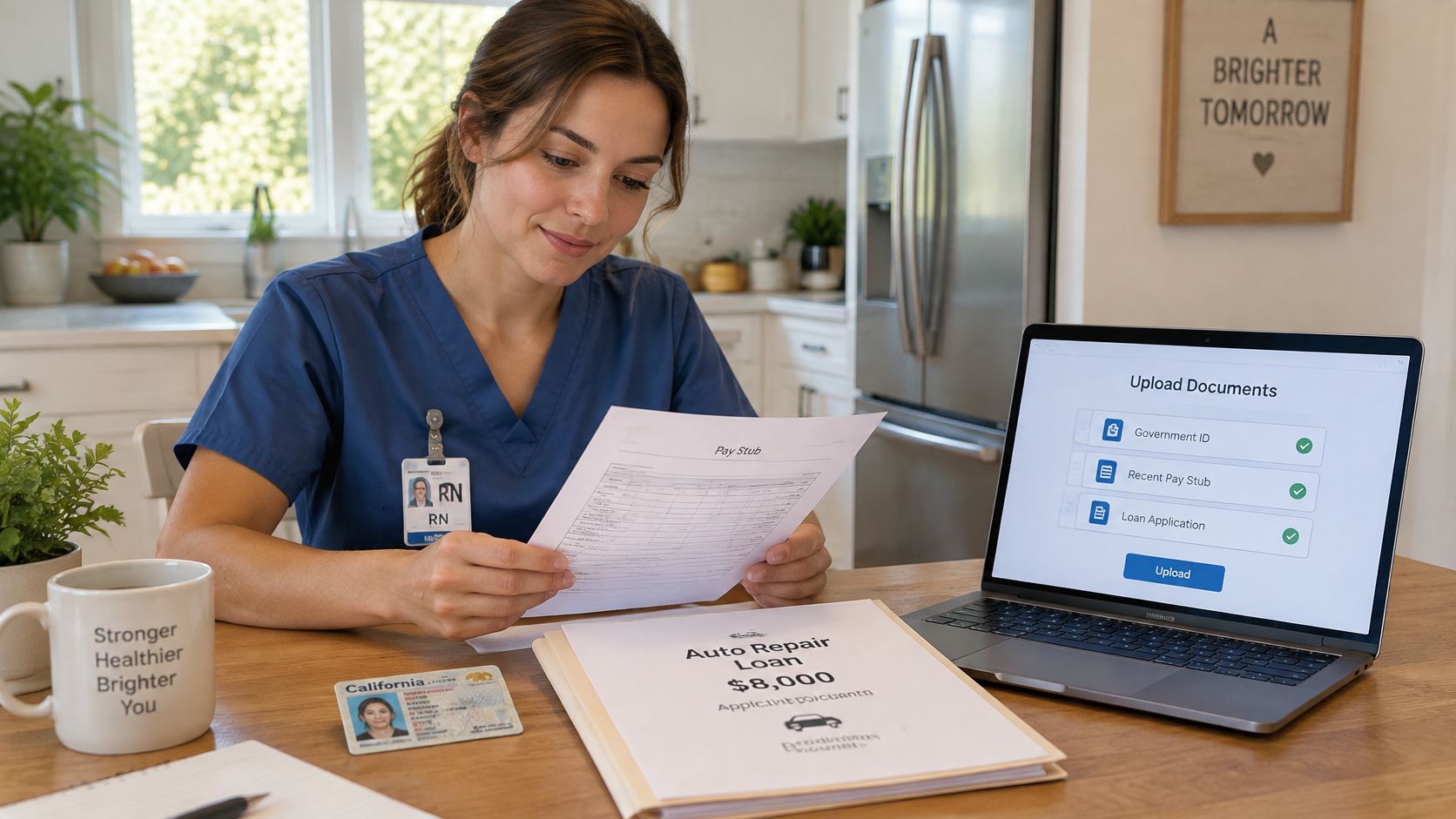
Maria is a salaried nurse borrowing $8,000 for a car repair. She uploads her government photo ID, enters her Social Security number, attaches a pay stub from the last 30 days, two years of W-2 forms, two recent bank statements and a utility bill. Her name reads identically on every page, so the file is easy to follow. The reviewer asks for one extra item, a short letter explaining a recent change in her pay rate, and the review continues once it arrives.
Dev is a freelance designer borrowing $8,000 for moving costs. His income is genuine but scattered across a dozen clients. He sends two years of tax returns, 1099 forms, invoices and twelve months of business bank statements. The lender asks him to explain several large one-time deposits and works out his income from net profit rather than from the gross invoice totals he hoped would count.
Same amount, different evidence, different questions. The reusable method fits on a note card:
- List every income source separately, including support payments, benefits and platform work.
- Name the document that proves each one, and check it covers the period the lender asked for.
- Flag anything you'd struggle to explain in one sentence, such as a large transfer or an unusual deposit, and write the explanation before you're asked.
Whichever borrower you resemble, the lesson is the same. Evidence, not loan size, shapes what a lender requests next.
Protecting Sensitive Documents Before You Upload
Your documents are the most sensitive material you'll handle in the entire loan process. Identity theft turns misused personal and financial information, including names, addresses, card numbers and Social Security numbers, into real harm, as USA.gov's identity theft guidance explains, and a loan file concentrates all of it in one place.
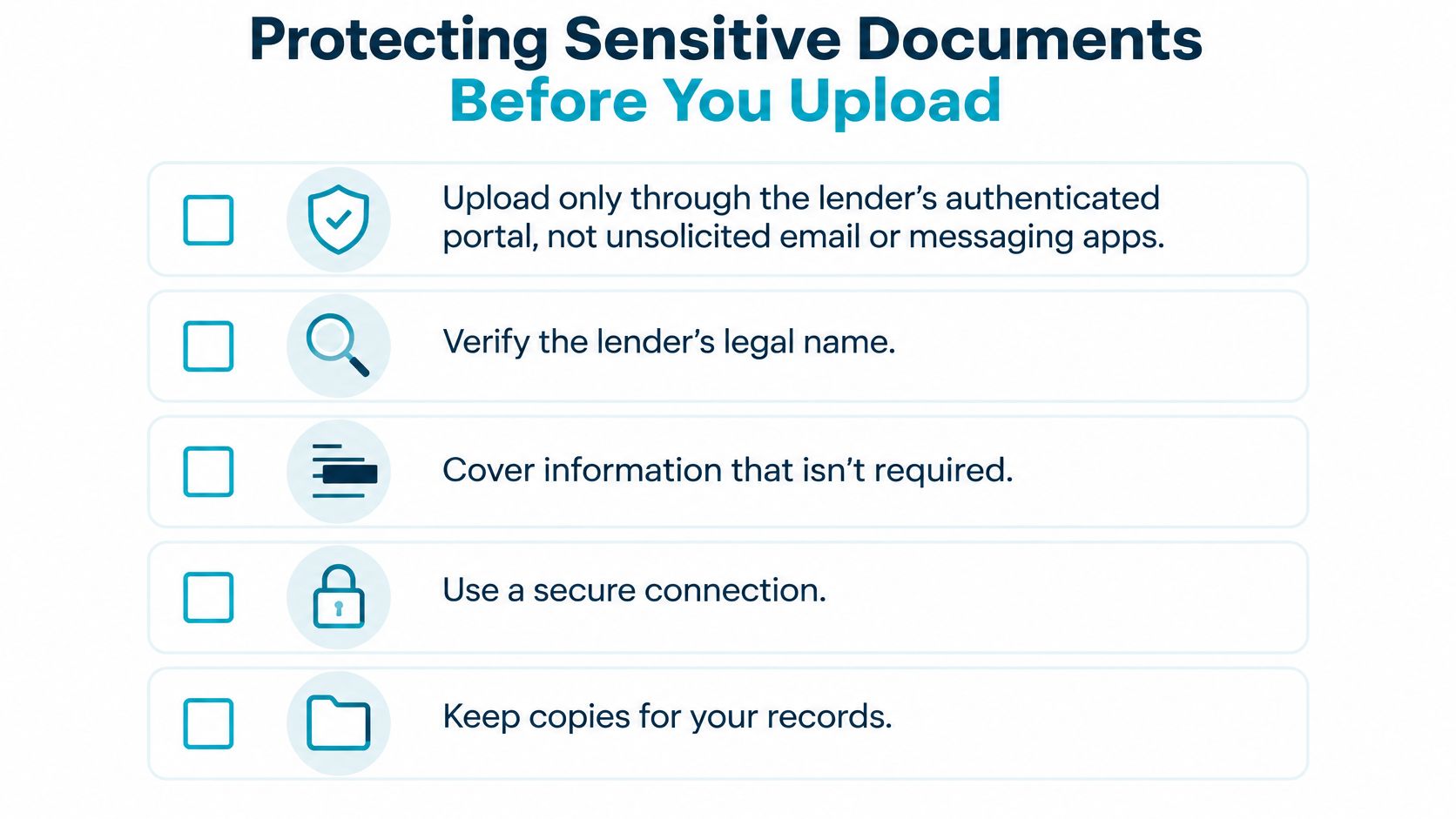
Work through these six checks before any upload:
- Use the lender's authenticated portal. Documents sent through unsolicited email or a messaging app sit outside the controls the lender built for them.
- Verify the legal name yourself. Look up the company independently rather than trusting a link or phone number that arrived in a message.
- Ask what's required before you send. Knowing which fields the reviewer needs lets you share a document and nothing extra.
- Redact only where permitted. Hidden unrelated account numbers are usually fine, but a covered name, date, deposit or balance can make the document unusable.
- Establish who receives the file. A referral service and a lender are different entities, and the one collecting your documents may not be the one making the credit decision.
- Treat payment requests as a warning sign. Being asked to pay before an offer exists, or for login details beyond what the portal needs, points to impersonation.
There's a standard behind some of these questions. Under the FTC Safeguards Rule, covered financial institutions must maintain a written information-security program and report certain breaches involving unencrypted customer information of 500 or more consumers to the FTC within 30 days after discovery, per the FTC's guidance on the Gramm-Leach-Bliley Act.
Share only what the request names, through the channel the lender uses, and keep a record of what you sent and when.
Before You Apply and What Happens Next
Preparation decides how quickly a request moves. Most delays trace back to a gap you could have closed before submitting.
Check Your File Before You Submit
- Match your income type to the evidence. Find your situation in the income table and confirm you hold every item that applies, not just the ones within easy reach.
- Ask each lender for its exact list. Document requirements are set lender by lender, and a file that satisfies one underwriting team may be short for another.
- Run a name and address check. Your name, address and employer should read identically across your ID, statements, stubs and application.
- Build one labelled folder. Name each file by purpose and date, such as
2026-03 pay stub, and keep a copy of everything you send.
Replace any missing or expired document before you apply. A partial file doesn't produce a faster decision, it produces a request for more evidence, and that costs you days.
The sequence from request to signed agreement follows a predictable shape.
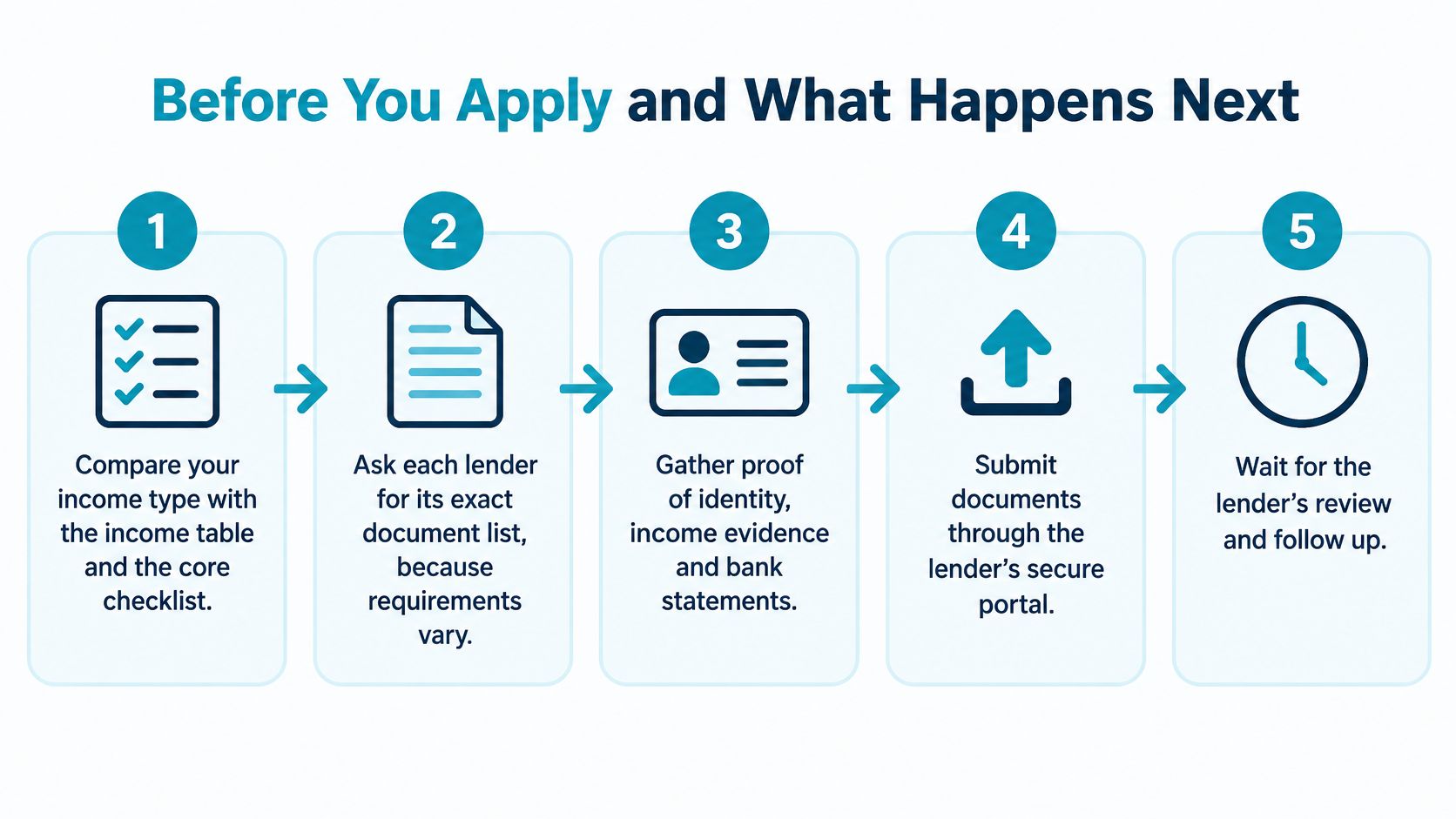
Submitting the request is the quick part. The online form takes minutes and asks for the loan amount, some personal information, and where the funds should be deposited. The personal loan application process walkthrough covers what happens at each stage.
Responding to document requests is where files separate. Upload through the portal you're given, and if you can't, ask whether faxing is available, because some circumstances still require application materials and other documents by fax. Then wait. Submitting information doesn't guarantee approval, and each lender applies its own criteria and sets its own terms.
Reviewing the offer comes before any signature. Your lender is required to disclose all fees and rates before you accept the loan, and you can decline an offer that doesn't fit. For a sense of what a competitive offer looks like, the average interest rate for a 24-month personal loan was 12.49% in the first quarter of 2024, according to Federal Reserve Board consumer-credit data. Compare any quoted APR against that figure with your own credit profile in mind, not as a pass or fail mark.
Signing electronically closes the loop. Since the E-SIGN Act took effect on June 30, 2000, electronic records and signatures can satisfy legal writing and signature requirements, but only after you affirmatively consent, receive a clear explanation of your rights, and are told which hardware and software you need to access and retain the documents. Save a PDF of the signed agreement and a record of that consent alongside your other copies.
NextStopLoans is an online marketplace rather than a lender. One secure request goes to a network of independent lenders, each of which makes its own credit decision and sets its own terms, and our How It Works and Rates and Fees pages spell out the details before you accept anything. If your documents are ready, start the request today. If they aren't, close the gaps first, because a complete file is the fastest thing you can bring to a lender.
Ready to put this into practice? NextStopLoans lets you submit one secure online request and routes it to a network of independent lenders, so you can compare offers without repeating the same application at every site. Gather your ID, income evidence and bank statements first, then visit NextStopLoans to start your request and review the terms each lender discloses before you sign.