
Personal Loan Interest Explained: APR, Rates and Costs

You've got a repair bill to pay or credit card balances you'd like to consolidate, and a loan offer shows a payment that looks manageable. But the payment alone doesn't tell you whether you're getting an affordable loan. You also need to know how much money you'll receive, what fees apply, and how many dollars you'll repay before you're done.
Personal loan interest becomes easier to understand when you separate three things: the advertised rate, the APR offered to you, and the total repayment. Each answers a different question. Your decision should start with a payment you can sustain and end with the full cost of getting out of debt.
Table of Contents
- How Personal Loan Interest Adds Up in Dollars
- Which Number to Compare
- What Sets the Interest Rate You Are Offered
- Benchmark Rates Show Where the Market Sits
- Fees and Penalties That Raise Your Real Cost
- Compare Offers Without Hurting Your Credit
- How to Evaluate a Lender's Offer Step by Step
- Choose the Offer With the Lowest Total Cost
How Personal Loan Interest Adds Up in Dollars
Think of interest as rent for using a lender's money. With a typical amortizing personal loan, the lender calculates interest on the principal balance you still owe. Principal is the borrowed money you haven't paid back yet.
Each scheduled payment covers interest and reduces principal. Early payments generally include more interest because your balance is larger. As you pay down that balance, more of the payment goes toward returning the money you borrowed.
What the same borrowed amount can cost
The following hypothetical examples use standard amortization, equal monthly payments, and no fees. Totals are calculated by multiplying the displayed, rounded monthly payment by the term. A lender's final payment may differ slightly because of rounding.
Monthly payment and total cost for sample personal loans
| Loan example | Monthly payment | Total repayment | Total interest |
|---|---|---|---|
| $5,000, 36 months, 10% APR | $161.34 | $5,808.24 | $808.24 |
| $5,000, 36 months, 20% APR | $185.84 | $6,690.24 | $1,690.24 |
| $5,000, 60 months, 20% APR | $132.46 | $7,947.60 | $2,947.60 |
The extended-term example has the lowest monthly payment but the highest total cost. That's the trap in judging a loan only by whether its payment fits this month's budget. A smaller installment can mean paying the lender for much longer.
You can check the arithmetic with an ordinary calculator:
- Find total repayment. Multiply the scheduled monthly payment by the number of payments, allowing for any different final payment.
- Find interest in a fee-free example. Subtract the borrowed principal from total repayment.
- Check the actual schedule. If fees, irregular payments, or changing rates apply, use the lender's disclosures rather than treating the simple calculation as complete.
For the hypothetical longer loan, the calculation is $132.46 × 60 = $7,947.60. Subtracting $5,000 leaves $2,947.60 in interest.
Use a personal loan calculator to test the relationship between payment and term, then compare the result with the lender's repayment schedule. Before accepting, write down monthly payment, total repayment, and total interest together. None should be hidden behind a large, reassuring payment figure.
Which Number to Compare
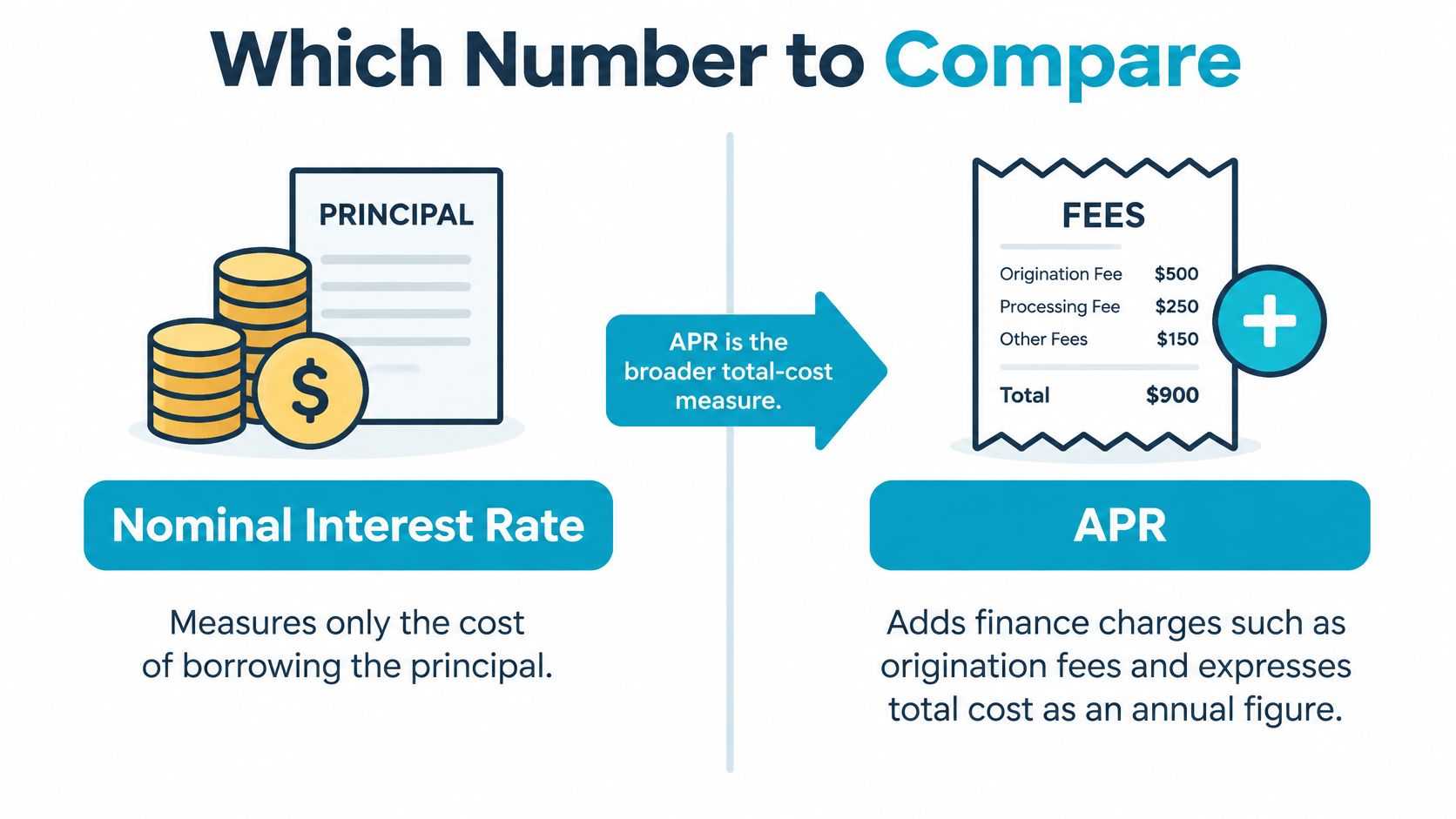
Say a hypothetical loan has a $5,000 principal, a 12% interest rate, and a $250 origination fee deducted before disbursement. You receive $4,750, but your repayment obligation is based on the full $5,000 principal. Because you're paying a financing charge while receiving less usable money, the APR is higher than the stated interest rate.
The nominal interest rate describes the interest charged on principal. Annual percentage rate, or APR, incorporates interest and applicable finance charges into an annualized comparison measure. It isn't the interest rate plus the fee percentage, and it isn't the total percentage you'll pay over the entire loan.
Under Regulation Z, APR relates the amount and timing of funds received to required payments, using prescribed calculation methods; the Consumer Financial Protection Bureau's APR guidance also explains the requirement for a single composite APR when different rates apply during different periods or to portions of principal.
Compare a complete offer, not a headline
APR is the better starting point for comparing financing costs, but you still need the surrounding terms. An annualized figure doesn't tell you how many years you'll keep paying, and it doesn't replace a dollar repayment total.
Record these details together:
- APR. Use the disclosed figure for your offer, not an advertised minimum.
- Principal and amount financed. Read the lender's labels carefully and distinguish them from cash deposited.
- Term. Identify how long repayment lasts.
- Payment schedule. Check payment amounts, frequency, and any different final installment.
- Total dollar repayment. Include required payments and account for separately paid charges without counting a fee twice.
A longer term can reduce each payment while keeping principal outstanding longer, usually increasing cumulative interest. That means a lower APR doesn't automatically establish the lowest lifetime cost when terms differ.
Comparison rule: Use APR to compare annualized financing costs and total repayment to understand the dollar commitment.
An advertised minimum is a possible starting price, not a promise. The useful APR is the one attached to the offer you can accept.
What Sets the Interest Rate You Are Offered
Credit profiles can help explain pricing differences, but they don't establish a rate you're entitled to receive. The following figures are illustrative comparison scenarios, not verified market averages, current quotes, or guaranteed prequalification results.
Illustrative personal loan APR by credit profile
| Credit profile | Illustrative estimated APR |
|---|---|
| Excellent credit | About 14.99% |
| Good credit | About 19.77% |
| Fair credit | About 24.17% |
| Bad credit | About 27.85% |
Don't use these scenarios as cutoffs for a good or bad offer. Without a defined scoring model, borrower population, loan term, and fee structure, a credit-profile label can't establish a dependable typical APR.
What lenders evaluate
Lenders generally price personal loans according to repayment risk. The Consumer Financial Protection Bureau's personal installment loan explanation identifies credit history, income, existing debts, loan amount, term, and other underwriting considerations as factors that can affect an offer.
Your credit score summarizes parts of your borrowing history, rather than your entire financial situation. Scoring models may consider payment history, outstanding debt, credit utilization, account age, recent applications, and adverse events such as collections or bankruptcy.
Lenders also need to assess whether a new payment is manageable:
- Income and employment. Reliable earnings help a lender evaluate your ability to make scheduled payments.
- Existing obligations. Debt-to-income ratio compares debt payments with income, giving context that a credit score alone doesn't provide.
- Requested amount and term. The size and duration of the obligation affect the lender's assessment.
- Additional underwriting information. Some lenders consider bank-account transaction information alongside traditional credit information.
Some states cap the APR and the amounts of charges for an online personal loan. Legal limits are a separate consideration from whether a particular offer fits your household budget.
Why lenders can quote different prices
Different lenders use different scoring models, eligibility rules, and underwriting standards. An applicant can therefore receive different offers without their financial circumstances changing between requests.
Our personal loan eligibility guide can help you identify the information to prepare before submitting a request. Accurate income, debt, and employment details make the information lenders evaluate more useful.
If an offer seems unexpectedly expensive, ask which factors influenced the price rather than assuming your score explains everything. Confirm whether the rate is fixed or adjustable, too. Your decision should rest on the actual offer and competing terms, not a broad credit label.
Benchmark Rates Show Where the Market Sits
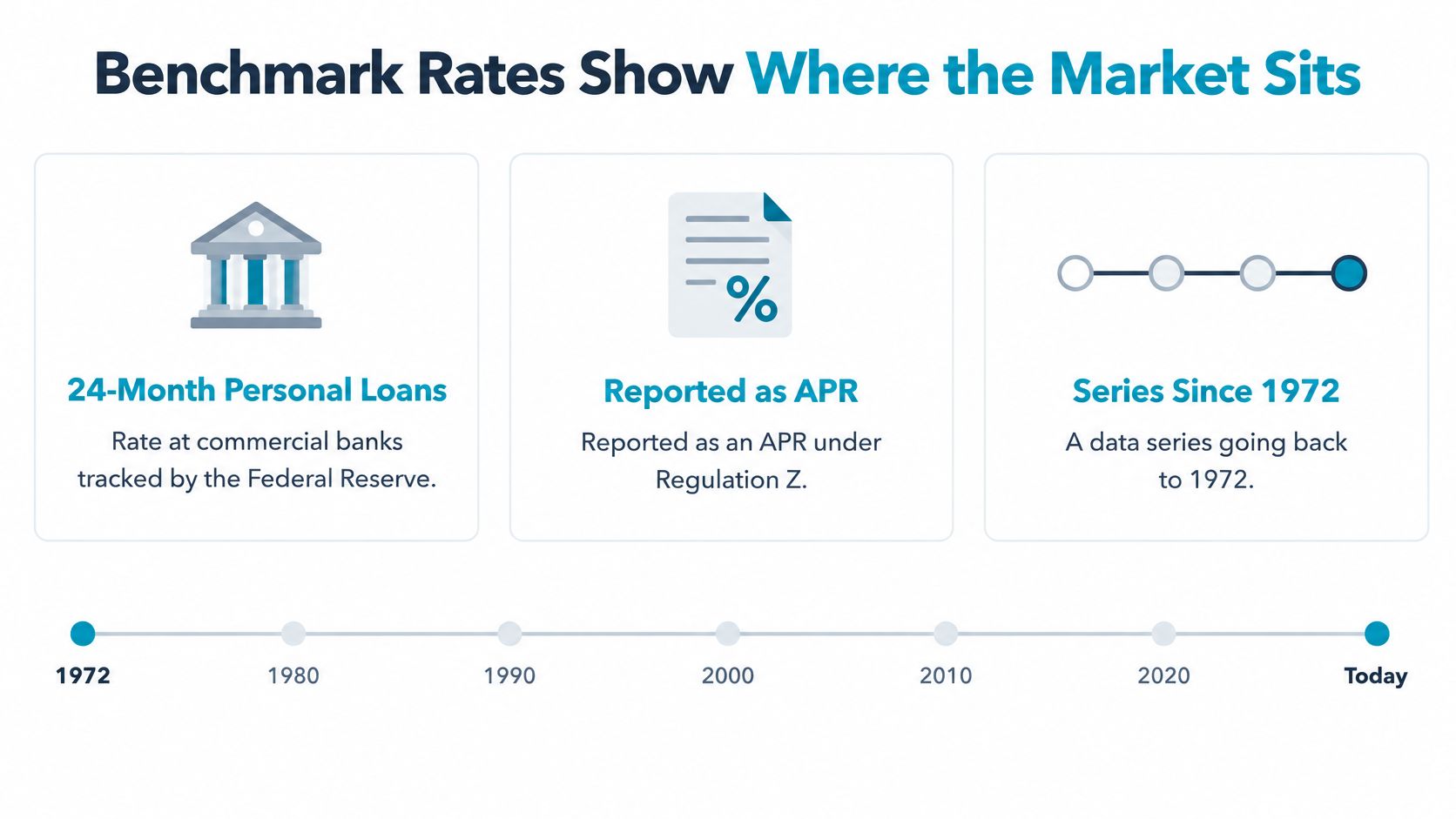
A bank-rate benchmark provides market context, not a personal price quote. The Federal Reserve's consumer-credit release reports the finance rate on 24-month personal loans at commercial banks, a series tracked since February 1972; its 2023 release reported 12.35% for the applicable period.
The rate is reported as APR under Regulation Z. It's a simple, unweighted average of each reporting bank's most common rate charged during the first calendar week of the middle month of each quarter. It isn't an average of every personal loan issued to every kind of borrower.
Put the benchmark in its proper place
The Federal Reserve's consumer-credit reporting reported an average rate of 11.50% in 2025 for this commercial-bank loan category. Historical observations help explain how bank pricing changes, but they aren't substitutes for current lender disclosures.
An offer from another type of lender may reflect different customers, loan sizes, terms, or underwriting standards. Your credit history, income, collateral where applicable, and state of residence can also affect the terms available to you.
A bank benchmark describes a category of lending. Your offer describes the obligation you would personally sign.
Use the benchmark as a prompt for questions rather than a pass-or-fail test. If your quoted cost looks high, compare other available offers with matching amounts and terms, then look for differences in fees and eligibility requirements.
A relatively low headline average doesn't establish that borrowing is affordable for someone with a strained budget. Affordability requires a workable payment and a total repayment you're willing and able to carry.
Fees and Penalties That Raise Your Real Cost
Personal loan interest is only part of the bill. Origination, documentation, and other additional fees may apply to an online personal loan. A fee deducted before funding also reduces the money available for the expense you're trying to cover.
Separate scheduled borrowing costs from charges triggered by something going wrong. That distinction helps you compare normal repayment with the consequences of a missed payment.
Identify the charges before signing
Look for these categories in the agreement:
- Origination and documentation charges. Establish whether they're deducted, financed, or paid separately.
- Late-payment fees. Our participating lenders have different late-payment policies, which are set out in their loan agreements.
- Non-payment fees and other penalties. These may apply to both short-term and online personal loans when payments are missed.
- Renewal charges. If renewal is offered, additional fees or interest can increase the remaining obligation.
Typical consequences of non-repayment may include late fees, referral to a collection agency, reporting to a consumer credit agency, and an offer to renew with additional fees or interest. These aren't necessarily automatic steps in a fixed sequence. The agreement explains the lender's policy.
Questions worth resolving
Before accepting, get clear answers to the following:
- Funding deductions. What will be taken out before the money reaches your account?
- First missed payment. When is a payment considered late, and what charge applies?
- Renewal. Is it offered, and what extra amount would you owe?
- Non-payment. What fees and collection provisions are included?
- Early payoff. Is there a prepayment penalty, and how is a payoff amount calculated?
Paying principal sooner can reduce interest on a balance-based loan, but don't assume every charge disappears when you repay early. Request a payoff quote that identifies what remains due.
A modest stated rate won't necessarily produce the lowest real cost if substantial charges apply. Compare the ordinary repayment obligation first, then assess whether the lender's penalty terms create risks your budget can't absorb.
Compare Offers Without Hurting Your Credit
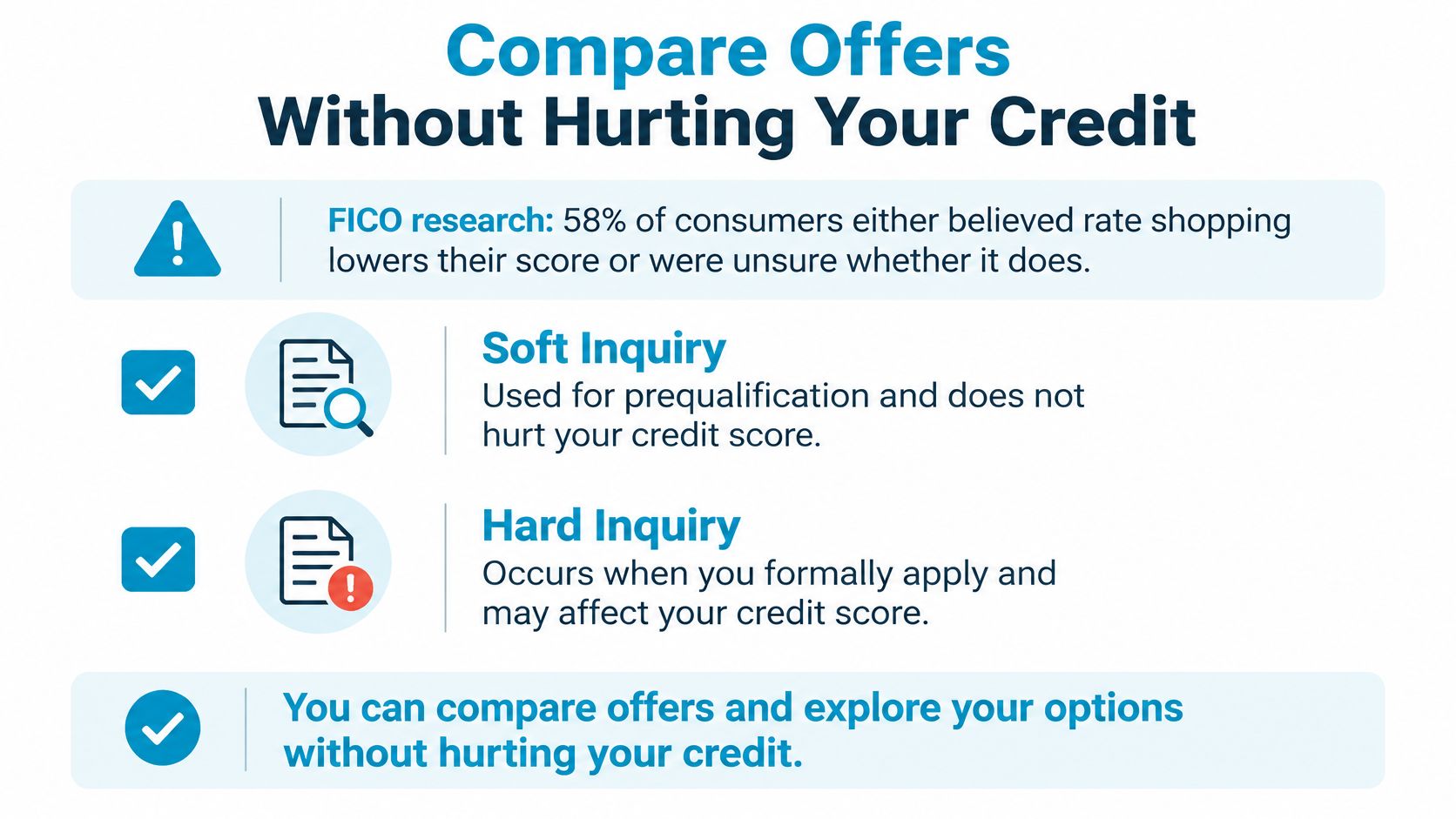
Confusion about credit checks can discourage useful comparison shopping. WHIO reporting citing FICO research found that 58% of consumers either incorrectly believed rate shopping lowers their score or were unsure whether it does; the report also notes that hard inquiries can remain on a credit report for up to two years, although their scoring effect generally diminishes sooner.
A soft inquiry used for prequalification doesn't affect your credit score. A formal application may involve a hard inquiry, which can affect it. Prequalification is also preliminary, so it shouldn't be mistaken for final approval or a binding rate.
Confirm what happens before you submit
Some scoring models give special treatment to grouped inquiries for certain loan products within a limited shopping period. Don't assume personal loan inquiries will always be combined. Treatment depends on the scoring model and loan category, and a lender's process determines when it requests your report.
Use this pre-application routine:
- Ask whether the initial check is soft or hard. Confirm the specific stage when a hard inquiry may occur.
- Read the consent language. Check which parties may obtain credit information and what you're authorizing.
- Avoid unrelated applications during shopping. Keep your attention on comparing the loan you need rather than opening other credit simultaneously.
Our marketplace doesn't pull credit, but participating lenders may check major or alternative credit bureaus. Sending information through a shared request process isn't automatically the same as avoiding credit inquiries.
For a closer explanation of the preliminary stage, consult our guide to personal loan soft pulls. Borrowers with limited credit histories or weaker credit should be particularly careful about repeated formal applications, because inquiry-related changes may affect eligibility or pricing.
The practical goal isn't to avoid comparison. It's to compare knowingly, using soft-check options where available and reserving formal applications for offers that merit closer consideration.
How to Evaluate a Lender's Offer Step by Step
During our loan request process, the lender provides the APR, loan fees, and other terms when you're redirected to the loan agreement. That's where you review the proposed obligation before deciding whether to accept.
We can't provide an exact APR in advance. The rate a borrower is charged depends on the lender's requirements, creditworthiness, state of residence, and the loan type and term.
Build a comparison you can actually use
Locate the APR and every fee in the agreement. Record them beside the other offers, using the final disclosures rather than a promotional headline. Save a copy so you can check the terms without relying on memory.
Write down the net amount you'll receive. Distinguish the face amount of the loan from usable proceeds after deductions. If the deposit won't cover the intended expense, the offer doesn't solve the same problem as one that does.
Match the amount and term when possible. Comparing different repayment lengths can obscure the reason one payment is lower. If matching terms aren't available, mark that difference prominently rather than treating the offers as equivalent.
Confirm the rate structure and first due date. Identify whether the rate is fixed or adjustable and whether the payment schedule aligns with your income. Don't assume the first payment falls after your next convenient payday.
Review missed-payment and renewal provisions. Identify the circumstances that trigger charges and whether renewal creates a new cost. Read the prepayment terms as well so you know how an early exit would work.
Keep the decision sheet simple
Use a consistent line for each offer:
Lender | APR | Net amount received | Term | Monthly payment | Total repayment | Separately paid charges
Calculate scheduled repayment from the actual payment schedule. If the lender lists a different final installment, use that amount instead of multiplying an identical payment across the entire term.
A clear record also helps you spot missing information. If you can't identify the usable proceeds or full scheduled obligation, pause before accepting rather than filling the gap with an assumption.
Choose the Offer With the Lowest Total Cost
Start by ruling out payments your budget can't reliably support. Among the remaining offers that provide the money you need, favor the lowest total cost at a sustainable term, using APR to help compare financing efficiency.
The shortest loan isn't automatically the right choice. If its payment leaves you unable to cover ordinary expenses, the apparent savings may come with an unacceptable risk of missing payments. A workable repayment plan needs room for normal household spending, not just the best-case month.

Recognize when to pause
An offer deserves more scrutiny when:
- The payment requires a perfect month. Leave room for routine fluctuations rather than committing every available dollar.
- The deposit falls short. A deducted fee may leave part of the original bill unpaid.
- The cost is difficult to justify. If comparable offers are substantially cheaper, establish why before proceeding.
- The term is longer than necessary. Don't extend repayment solely because the smaller payment looks more comfortable.
Budget test: Choose a payment you can maintain without needing another loan to make it.
Our online request process routes a single request to a network of independent lenders. The form takes minutes to complete and asks for the amount requested, personal information, and where funds should be deposited. Lenders, not our marketplace, make approval decisions and set the final terms.
Before submitting, test different repayment lengths with a payment estimator. Our calculator estimates monthly payment, total interest, payoff date, and balance changes over time, with a rate and term preset for each loan type. Replace assumptions with the offered terms when they become available.
You don't have to accept an offer just because it's presented. Submitting information online doesn't guarantee approval, and a preliminary estimate doesn't establish your final APR. Accept only after you can explain, in plain dollars, what you'll receive and what you'll repay.
NextStopLoans offers an online marketplace connecting loan requests with independent lenders, along with a calculator for testing repayment costs. Visit to estimate a payment you can sustain, then review any lender offer by its APR, usable proceeds, and total dollars repaid before deciding whether to accept.